My historical fiction trilogy, comprised of Born Blind, A Potter’s Vessel, and Killing Force (details of the story in each volume can be found on the specific pages for that work).
Why wasn’t the issue of the constitutionality of secession resolved by the judicial process as provided in the express language of the Constitution: “The judicial Power shall extend to all cases, in law and equity, arising under this Constitution,…”?
Would a state’s petition to secede from the Union in 1860 have changed the course of American history?
Could the sacrifice of over 600,000 American lives have been averted if our self-proclaimed “government of laws, not men” had looked to the Constitution to resolve its greatest conflict?
Answering these questions has taken me seven years and nearly 1500 pages, but the journey has been very rewarding to me. I think you will learn a few things about our nation’s history if you follow along.
The 19th century saga recounts the Scott family’s rise from ambitious frontier settlers in the new state of Tennessee, to prosperous slave-holding planters, to officials serving at the highest levels of state and federal governments. The Scott sons and their blind slave each play a vital role in the secession crisis brewing in the nation.
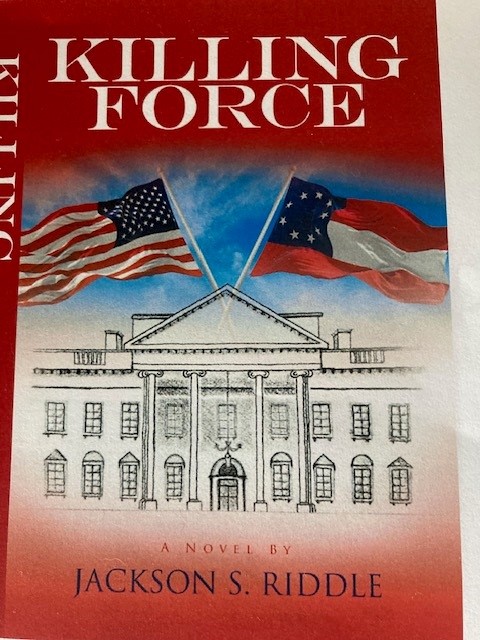

(Killing Force cover image in progress. Artist in Residence, Jennifer Stone Rose)
“Great Historical Fiction Series! Unorthodox yet superbly unbiased and balanced in its historical accounting of an extraordinary what-if scenario.” – Amazon reviewer, West Point graduate and foreign war veteran
“…intriguingly explores its themes of legality and justice.” Kirkus Reviews
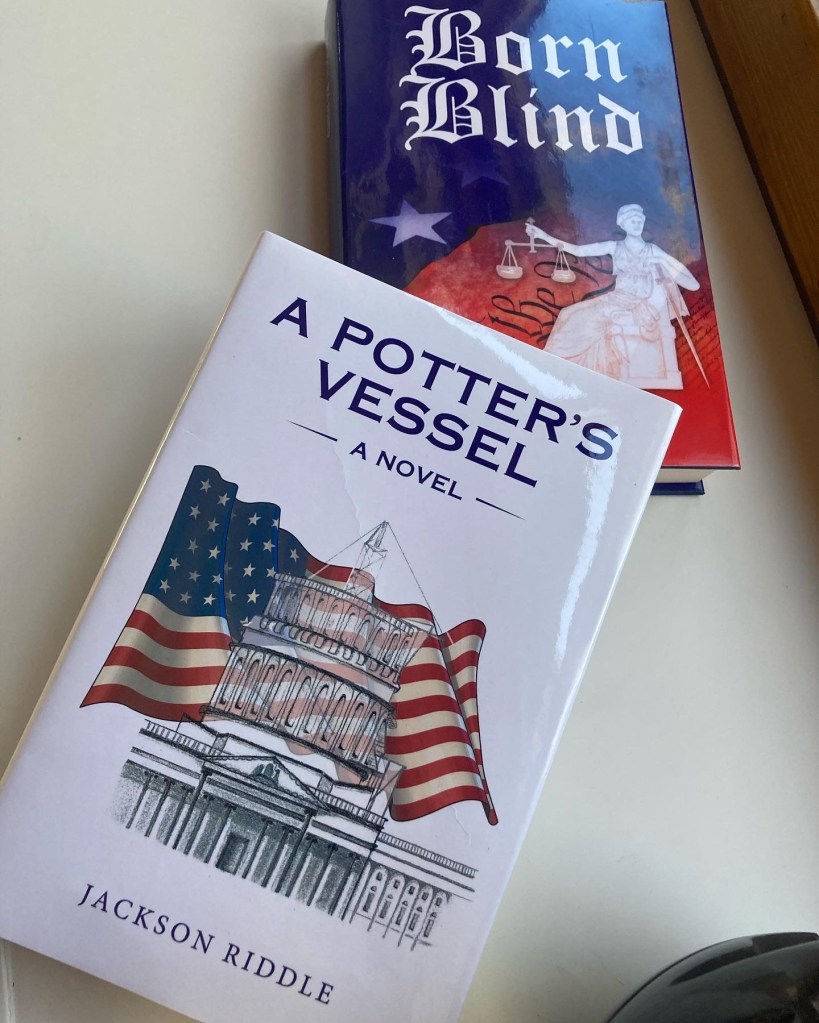
Born Blind and A Potter’s Vessel are novels about what should have happened in the United States in 1860, or any time prior to July 21, 1861, the date the Civil War truly began with the first Battle of Bull Run.
In this series, I have staged an alternative battle for the soul of the Nation – one fought in the Supreme Court chamber in Washington rather than in the cotton and wheat fields of the country’s heartland. The inherent limitations of the Constitution, and the flaws of the men who interpret it, are dramatically exposed in this legal struggle over the future of the Union.
Does the Constitution dictate that the votes of only five justices can validate Tennessee’s withdrawal from the union? Or does the vote of the people and the congress trump the power of the judiciary?
Is the nation still under construction, or is it destructing?
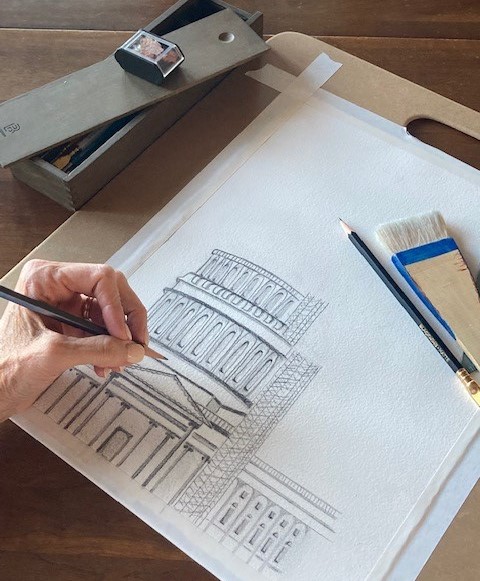
Cover art by Jennifer Stone Rose, artist-in-residence.
I have gotten several inquiries about the nature of historical fiction, and the distinction between fact and fiction. I have distilled my responses to these questions with respect to my approach into three points that might be useful as you read.
- My premise is, of course, fiction, but most of the action in the book is based on historical fact.
- All characters in the book are historical figures except the Scott family and their slaves. The dialogue for all characters is imagined, except for that appearing in historical documents.
- All text in italics are quotes from historical documents except for the letters exchanged between the Scott brothers, which are fictional but which deal mostly with historical events.
I have gotten other questions about the inspiration for this work. As a lawyer, I started with the nagging question of why the issue of secession was never litigated. I asked a few knowledgeable colleagues the question and was met with blank stares. I then began consulting a long list of books to continue seeking an answer to the question. Surprisingly, I found no discussion of the scenario – none. So I decided to create one myself, based on my own legal background and somewhat obsessive interest.
Time: 1832-1860
Primary locations:
– Panther Springs, TN (30 miles NE of Knoxville on the Holston River) – prosperous slave-managed farm of the Scott family;
– Nashville, TN – various sites, including the State Capitol building, and Polk Place, home of Sarah Polk, widow of 11th President of the United States;
– West Point, NY – United States Military Academy;
– Kansas Territory – various sites in “Bleeding Kansas”;
– Washington City – various sites, including the Capitol Building and the Executive Mansion of these United States.
Principal Characters:
The Scott Family – all fictional:
– Jeremiah Scott (b. 1798) – successful planter in East Tennessee; Christian slave-holder supporting emancipation;
– Sarah Scott – (b. 1806) – Jeremiah’s wife; supportive of emancipation;
– Rachel Scott- (b. 1780) Jeremiah’s mother, widow of Jonathan; Christian slave-holder and educator for her family; opposes emancipation;
– Capt. Lee Scott (b. 1826) – Jeremiah’s and Sarah’s eldest son; Mexican War cavalry volunteer; U.S. military academy graduate; served with distinction in Kansas Territory; supports continuation of slavery and supports secession;
– Jerald Scott – (b. 1827) – Jeremiah’s and Sarah’s second son; lawyer and Tennessee state representative; opponent of slavery; opponent of secession, but architect of constitutional secession petition by the state of Tennessee.
The Morris Family – all fictional:
– Zechariah “Zech” Morris – (b. ca. 1804) – Slave purchased by Jonathan Scott at auction when he was about six; raised with Jeremiah; now grown and acting as overseer of Scott farm;
– Eliza “Liza” Morris – (b. unknown) – Zech’s wife, purchased by Jeremiah from neighboring farm to marry Zech; house maid to Sarah and Rachel Scott;
– Gamaliel “Gam” Morris – (b. 1832) – only son of Zech and Liza; blind from birth; raised mostly by the Scotts in the family manor home rather than by the Morris’ in their cabin by the river; educated by Rachel Scott and Tennessee School for the Blind.
Others – all historical:
– William Brownlow – (b. 1805) – firebrand publisher and editor of Brownlow’s Knoxville Whig, most widely-circulated newspaper in East Tennessee; ardent supporter of slavery and opponent of secession; fervently anti-Democratic Party;
– Sarah Childress Polk – (b. 1803) – widow of James K. Polk, 11th President of these United States; slave-holder and owner of plantation in MS purchased by her husband while he was president; continuing political force in Tennessee and Washington City; resides at Polk Place, family mansion in Nashville near the Tennessee Capitol;
– John C. Catron – (b. 1786) – Associate Justice of the United States Supreme Court appointed by President Jackson on the final day of his presidency, March 4, 1832; previously served as Chief Justice of Tennessee Supreme Court of Errors and Appeals; married to Matilda Childress, cousin of Sarah Polk; author of many opinions upholding slavery; personally opposed to secession;
– Matilda Catron – (b. 1802) – wife of Justice John Catron and cousin to Sarah Polk;
– Washington Whitthorne – (b. 1825) – Lawyer and Speaker of the Tennessee House of Representatives; childhood mentee of James K. Polk and adult friend of his widow, Sarah Polk; publicly supportive of slavery; privately opposed to secession;
– Isham Harris – (b. 1808) – Lawyer and Democratic Governor of Tennessee; plantation owner and ardent proponent of slavery and secession;
– George Washington Custis Lee – (b. 1832) Lieutenant, United States Corps of Engineers; graduated first in the U.S. Military Academy class of 1854; eldest son of Captain Robert E. Lee; inherited owner of Arlington House, subject to life-estate in favor of his mother, Mary Anna Custis Lee, and now managed by his father, Rob’t Lee.
– Harriet “Hal” Lane – (b. 1830) – niece of President James Buchanan, official hostess to the president at the executive mansion, 1857-1860;
– John W. Head – (b. 1822) – Tennessee Attorney General, tasked with prosecuting the state’s secession petition before the U. S. Supreme Court.
– U. S. Supreme Court Justices: Chief Justice Roger Taney, John McLean, James Wayne, Peter Daniel, Samuel Nelson, Robert Grier, Benjamin Curtis, John Campbell, Nathan Clifford;
– Andrew Johnson, U. S. Congressman from Tennessee;
– Colonel John James Abert – (b. 1788) – Chief of the U. S. Topographical Corps of Engineers.
Bibliography – Below is a list of many of the sources used in writing these books:
- Narrative of the Life of Frederick Douglass, an American Slave, Frederick Douglass
- Confederates in the Attic, Tony Horowitz
- Spying on the South, Tony Horowitz
- We Have the War Upon Us, William Cooper
- The Impending Conflict, David Potter
- Lady First, Amy Greenberg
- The Unvanquished, William Faulkner (multiple readings)
- Secession on Trial, Cynthia Nicoletti
- Gone With the Wind, Margaret Mitchell
- The Bondwoman’s Narrative, Hannah Crafts
- Mrs. Lincoln’s Dressmaker, Jennifer Chiverina
- Top 100 Constitutional Law Cases, ed. AudioLegal Team
- We Hold These Truths, Mortimer Adler
- Uncle Tom’s Cabin, Harriet B. Stowe (multiple readings)
- These Truths, Jill LePore
- Lincoln and the Chief Justice, James Simon
- Lincoln and the Decision for War, Russell McLintock
- Sarah Childress Polk, a biography, Bumgarner
- William G. Brownlow, Coulter
- San Antonio – A Tricentennial History, Miller
- Heart of the Valley, a History of Knoxville, Deaderick, ed.
- The Road to Disunion!, William Freehling
- Robert E. Lee, Roy Blount, Jr.
- Ratification, Pauline Maier (multiple readings)
- We the States, VA Comm. on Const. Gov’t
- The Federalist Papers, James Madison, John Jay, Alexander Hamilton
- “John Catron and Jacksonian Jurisprudence,” Allen
- “Tennessee Reaction to Nullification,” Bergeron
- “The Use of the Federal Injunction in Constitutional Litigation,” Lockwood
- “Party Politics and the Debate Over the Tennessee Negro Bill,” So. Hist. Journal
- “When Can a State Sue the U.S., 101 Cornell Law Rev. 851
- History of the Supreme Court, Peter Irons
- “The Lost History of the Political Question Doctrine,” Grove, NY Law Rev.
- “Political Questions, Public Rights, and Sovereign Immunity” Note 130 Hou. Law Rev. 723
- “Supreme Court Justices: A biographical dictionary”, Hall
- “Pioneers, Patriots and Politicians: The Tennessee Militia System, 1772-1857”, Smith
- Beloved, Toni Morrison
- The Real Lincoln, Thomas DiLorenzo
- “John C. Calhoun and the Secession Movement of 1850”, Am. Antiq. Soc., April, 1918
Letters of a Nation, A. Carroll, ed. - Sweet Taste of Liberty, Caleb McDaniel
- Worst. President. Ever., Roberty Strauss
- Midnight Rising, Tony Horowitz
- Presidents of War, Michael Beschloss
- A Disease of the Public Mind, Thomas Fleming
- This Vast Southern Empire, Matthew Karp
- The Saddest Words, William Faulkner’s Civil War, Michael Gorra (multiple readings)
- “Baseball and the White House in the Nineteenth Century,” http://www.whitehousehistory.org.
- Summoned to Glory, The Audacious Life of Abraham Lincoln, Richard Striner (multiple readings )
- “The Buchanan-Douglas Feud”, Auchampaugh, Journal of the Illinois State Historical Society (1908-1984)Vol. 25, No. 1/2 (Apr. – Jul., 1932), pp. 5-48
- Without Precedent, The Life of John Marshall, Joel Richard Paul
- Apostles of Disunion, Charles Dew
- “William Henry Bissell”, Journal of Illinois State Historical Society, Vol. 36, No. 1 (Mar., 1943)
- “Thematic Survey of Springfield’s African-American Community,” Mansberger and Stratton, Springfield Historic Sites Commission (2018)
- Calhoun, American Heretic, Robert Elder
- The War Before the War, Andrew Delbanco
- “The Strangely Insignificant Role of the U. S. Supreme Court During the Civil War,” Jonathan W. White, Journal of the Civil War Era (Vol. 3, No. 2, June, 2013)
- “A Conservative in Lincoln’s Cabinet: Edward Bates of Missouri”, University of Missouri, St. Louis, ILR@UMSL, Mark Alan Neels, Thesis (May 12, 2009)
- Speech of Senator Stephen Douglas, Senate Floor, January 3, 1861, Congressional Globe,
- “Stopping Time: The Pro-Slavery and ‘Irrevocable’ Thirteenth Amendment”, A. Christopher Bryant, U. of Cincinnati College of Law Scholarship and Publications, 2003
- Life and Speeches of Thomas Corwin: Orator, Lawyer and Statesman, 1896 (ed., Josiah Morrow)
- “Presenting the Case for the United States as it Should Be: The Office of Solicitor General in Historical Context,” Seth P. Waxman, lecture before the Supreme Court Historical Society, June 1, 1998
- Lincoln on the Verge, Ted Widmer (twice)
- The Civil War as a Theological Crisis, Mark Noll
- Decision in Philadelphia, Christopher Collier and James Lincoln Collier
- History of the Lost State of Franklin, Samuel Cole Williams
- Absalom, Absalom!, William Faulkner (still the greatest American novel, after at least a dozen readings)
- On Augustine, Rowan Williams (dense but profound in many respects)
- The Mansion, William Faulkner (multiple readings, favorite of the Snopes trilogy)
- Calhoun, American Heretic, Robert Elder
- The War Before the War, Andrew Delbanco
- Lincoln on the Verge, Ted Widmer
- The Civil War as a Theological Crisis, Mark Noll
- The Saddest Words, William Faulkner’s Civil War, Michael Gorra
- History of the Lost State of Franklin, Samuel Cole Williams
- My Reading Life, Pat Conroy
- Decision in Philadelphia, J. Collier and S. Collier
- The Coming Fury, Bruce Catton
- Polk, The Man who Transformed the Presidency and America, Walter Borneman
- John Tyler, The Accidental President, Edward Crapol
- The Problem with Lincoln, Thomas DiLorenzo
- Break it Up, Richard Kreitner (twice)
- James Madison, America’s First Politician, Jay Cost
- Rebels in the Making, William Barney
- Madness Rules the Hour: Charleston, 1860, Paul Starobin (three times)
- “Internal Dissent: East Tennessee’s Civil War – 1849-1865”, Meredith Anne Grant, East Tennessee State University, Master’s Thesis (2008)
- “The Economic Structure of Rural Tennessee – 1850-1860”, Frank L. and Harriet C. Owsley, The Journal of Southern History, Vol. 8, No. 2 (May, 1942),
- “Life Portrait of James Buchanan,” https://www.c-span.org/video/?125214-1/life-portrait-james-buchanan.
- “Life Portrait of Andrew Johnson,” https://www.c-span.org/video/?150104-1/life-portrait-andrew-johnson.
- “Life Portrait of Abraham Lincoln,” https://www.c-span.org/video/?125640-1/life-portrait-abraham-lincoln
- 1861: The Civil War Awakening, Adam Goodheart
- The Myth of the Lost Cause, Edward Bonekemper
- Freedom at Risk: The Kidnapping of Free Blacks in America, 1780-1865, Carol Wilson
- The Broken Constitution, Lincoln, Slavery, and the Refounding of America, Noah Feldman (twice)
- The U. S. Constitution and Secession, A Documentary Anthology of Slavery and White Supremacy, Dwight Pitcaithley, ed.
- Tennessee Secedes, Dwight Pitcaithley
- The End of the Myth: From the Frontier to the Border Wall in the Mind of America, Greg Grandin
- The Cause, the American Revolution and its Discontents, 1773-1783, Joseph J. Ellis
- Parties, Politics, and the Sectional Conflict in Tennessee – 1832-1861, Jonathan M. Atkins
- The Constitution: An Introduction, Michael Stokes Paulsen and Luke Paulsen
- Lincoln, Aaron Vidal
- Free to Move, Ilya Somin
- “Internal Dissent: East Tennessee’s Civil War, 1849-1865”, Meredith Anne Grant, Master’s Thesis, East Tennessee State University, August, 2008
- “New York and the Fusion Movement of 1860”, Journal of Illinois State Historical Society, Vol. 16, No. 1/2 (Apr. – Jul., 1923), pp. 58-62.
- “A Survey of Civil War Period Military Sites in Middle Tennessee,” Tennessee Department of Archaeology, Division of Conservation, Report of Investigations No. 7 (1990)
- “The Assertions of a Secessionist”, Alexander H. Stephens, Nov. 14, 1860
- “James Buchanan and the Crisis of the Union,” Frank Wysor Klingberg, Journal of Southern History, Vol. 9, No. 4, pp. 455-474; Nov. , 1943.
- Who Decides? States as Laboratories of Constitutional Experimentation, Jeffrey Sutton
- A Wicked War, Amy Greenberg
- “A Marbury v. Madison Moment on the Eve of the Civil War”, McAlister, Stephen R., 14 Green Bag 2d 405 (2011).
- John Quincy Adams, Harlow Giles Unger
- The Crooked Path to Abolition, James Oakes
- 51 Imperfect Solutions, Jeffrey Sutton
- “George Washington Custis Lee”, The Virginia Magazine of History and Biography, Vol. 48, No. 4 (Oct., 1940)
- No Property in Man, Sean Wilentz
- Divided We Fall, David French
- A Country of Vast Designs, Robert Merry
- “Party Politics and the Debate Over the Tennessee Free Negro Bill, 1859-1860”, Jonathan M. Atkins, Journal of Southern History, Vol 71, No. 2 (2005)
- Seeds of Empire: Cotton, Slavery, and the Transformation of Texas Borderlands, Andrew Torget (2018)
- The Words That Made Us, America’s Constitutional Conversation, 1760-1840, Akhil Amar
- “Akhil Amar’s Unusable Past”, Gregory Ablavsky, 121 MICH. L. REV. 1119 (2023)
- “Commentaries on the Constitution of the United States”, Joseph Story (1833)
- The Second Founding, Eric Foner
- The Quartet, Joseph J. Ellis
- The Nation that Never Was, Kermit Roosevelt III (multiple readings)
- Founding Brothers: The Revolutionary Generation, Joseph J. Ellis
- “The Life and Career of Edwin McMasters Stanton”, Price, Mary Louise (1968) Plan B Papers, 569; The Keep, Eastern Illinois University, January 1, 1968
- Treaties and Other International Agreements: The Role of the United States Senate, 106th Congress, 2d Session (2001)
- “The Revolution in Tennessee, February, 1861, to June, 1861”; J. Milton Henry, Tennessee Historical Quarterly, Vol. 18, No. 2 (June, 1959), pp. 99-119 (21 pages)
- Gary S. Lawson, When did the Constitution Become Law?, 77 Notre Dame Law Review 1 (2001).
- Vasan Kesavan, When did the Articles of Confederation Cease to be Law? 78 Notre Dame Law Review 35 (2002)
- We the People, Ackerman, Harvard University Press
- Amar, The Words that Made Us: America’s Constitutional Conversation (Basic Books)
- Amar, “Philadelphia Revisited: Amending the Constitution Outside Article V”, 55 U. Chi. L. Rev 1043 (Fall, 1988)
- Amar, “The Consent of the Governed”, 94 Col. L. Rev. 457 (Fall, 1994)
- Ackerman, “Discovering the Constitution, Yale Storrs Lectures”, 93 Yale L. Journal 1013 (1984)
- Barnett, “The Declaration of Independence and the American Theory of Government: First Comes Rights, and Then Comes Government”, Harvard Journal of Law and Public Policy, Vol. 42, Issue 1, 23-28
- American Visions, Edward L. Ayres
- Behind the Scenes, Thirty Years a Slave, Elizabeth Keckley
- The Demon of Unrest, Erik Larson
- The President’s Power in the Field of Foreign Relations, Memorandum Opinion for the Attorney General, November 8, 1937;
- “Is the President’s Recognition Power Exclusive?” Robert J. Reinstein, 86 Temple Law Review, No. 1, Fall, 2013
- The Civil War, Fort Sumter to Perryville, Shelby Foote
- The Cause, Joseph J. Ellis
- The Problem with Lincoln, Thomas J. DiLorenzo
- American Scripture, Pauline Maier
 JACKSON S. RIDDLE