More than a puny, inexhaustible, voice
June 19, 2025
The End of a Seven Years’ Journey, and the Continuation of our Nation’s Struggle
When I last wrote on this page, I apologized for a nine-month hiatus. I didn’t expect that the ensuing one would cover over twenty months, but such is the struggle for routine in my life these days. But what is noteworthy is actually the conclusion of a much longer period in my life – that which has taken me from conception to completion of my Nation of Laws trilogy. I don’t recall the exact moment when I began to ponder the constitutional dilemma at the core of my story, but it was sometime in 2018 when the question presented crystalized: why wasn’t the issue of the constitutionality of secession ever litigated in the courts like all other constitutional issues? Formulating that seemingly simple question about American history turned into an odyssey that lasted over seven years and now covers almost 1,500 pages of text. Sometimes your mind takes you places you could never imagine!
Killing Force, the third and final volume in my historical fiction saga, will be released July 21, 2025. I picked that date advisedly, not just because it was a realistic target for completion of the work that I began on January 1, 2022. Rather, it is the perfect date to close this period in my writing life, since it will be the 164th anniversary of the First Battle of Bull Run, marking the true beginning of the American war between the states. July 21, 1861, also happens to be the date on which my saga concludes, and it does so on Henry Hill, where the first civilian casualty of the war fell and where the tide of that particular battle turned.

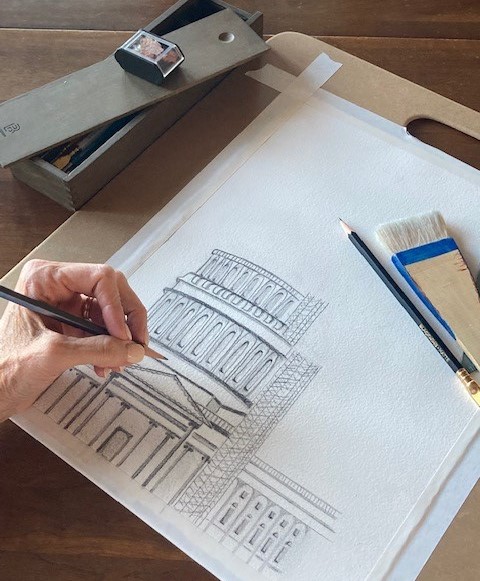
(Cover art in process…. My personal in-house artist Jennifer Stone Rose at work.)
Executive power is a topic of fierce debate in the nation today. The same issue was apparent in 1861, but the actions of the then chief executive has never received the same intense scrutiny as has today’s occupant of the Executive Mansion. That scrutiny is my mission in Volume 3 of Nation of Laws.
That’s all I will disclose for now about the action, or the final resolution of my reimagined history. I hope you are looking forward to reading it as much as I am proud (and relieved) to present it to you. Seven years is a considerable amount of time to devote to one project, but it has been worth it to me. I am happy with what I have done and believe I have made a valuable contribution to our history. I hope that someday it may be widely understood.
October 13, 2023
Trying to get back in the game
As you can see from the date of my last entry, it has been nine months since I updated you on my work. That doesn’t mean that I have not been writing, of course. I have, and the work is coming along after an extended time away. I am on Chapter 19, page 183, of the first draft of Killing Force, the third and likely final installment in my historical series, Nation of Laws. The end of the story is not developing as quickly as I would prefer, but as you probably know much happened in the nation between November 6, 1860, and April 12, 1861. Since I am already 1100 pages into my recounting of the events leading up to the firing on Fort Sumter by the Confederate artillery, there is no reason to take any shortcuts now.
Further, my time for writing this month is impaired, as it is every October, by the MLB post-season. Even if I was fully energized to write historical fiction, present-day baseball would divert my attention. I can only find the time to write this blog entry this morning because after just the first two rounds of the play-offs, there are two consecutive days without any games (for the second time already)! (MLB needs to fix that scheduling anomaly, and I have a few thoughts on how to do just that on my baseball blog. (See http://www.babesbaseball.com.)
That said, I am a little upset with myself when I realize that next month will mark two years since A Potter’s Vessel was published as volume two of the series, which was only fourteen months after the publication of volume one, Born Blind. I did not expect the third volume to take so much longer to complete, but then I did not anticipate several events that have intervened, some much more serious than whether the Astros can repeat as World Series champions. Indeed, just the comparison of the two makes me wince.
The worst of these events (all events?) was the sudden death of our eldest daughter on September 30, 2022. I realize now that I have said nothing about that tragedy on this site, although I have written many thoughts about her on my baseball site. (See entries for October 6, and November 30, at this link: https://babesbaseball.wordpress.com/major-league-baseball-2022/; or this post: https://babesbaseball.wordpress.com/2023/05/27/memorial-day-reflections-how-baseball-heals-us/.)

(Alix Renee Rose, May 27, 1996 – September 30, 2022)
The second link may be more appropriate today given that it was written as a Memorial Day memory, and the world is once again on the verge of global conflict and one where the combatants do not even purport to subscribe to the laws of war. (https://www.ohchr.org/en/instruments-mechanisms/instruments/geneva-convention-relative-protection-civilian-persons-time-war.) The suffering being experienced on both sides at this moment in Israel and Gaza, or Ukraine and Russia, are greater tragedies than my own, but I am not much more equipped to address the global strife than I am for my own internal struggle.
Obviously, the adjustment to my personal loss had an impact on my ability to write. Not only was it hard to focus on the task of writing, but when I did find the energy and concentration to do so I couldn’t decide which project to work on. The family memoir that is listed among my Works is focused largely on our daughter, and you might have noticed that it is entitled Part I. After the phone call I received on the morning of September 30, 2022, I have been thinking a lot about the writing of Part II. Yet, the event is still too near, too real, to permit me to write about. Likely, a time will come when I will feel compelled to write out the pain of losing a child, but not yet. And in a way, the events of the past ten days in the Middle East have actually increased my desire to finish Killing Force. Once again, we see man’s inhumanity to man and the seemingly inevitable resort to murder to resolve conflicts not just among peoples of competing ethnic origins, but even those of near identical backgrounds. Therefore, I am back at work on the history of our Nation, and the failure of her leaders to rise to the occasion when the rule of law was most needed. As I hope you have discerned through reading volumes one and two, in the light of current events the need for discerning leaders is as great today as it was then.
January 10, 2023
Starting off the New Year with a Booster
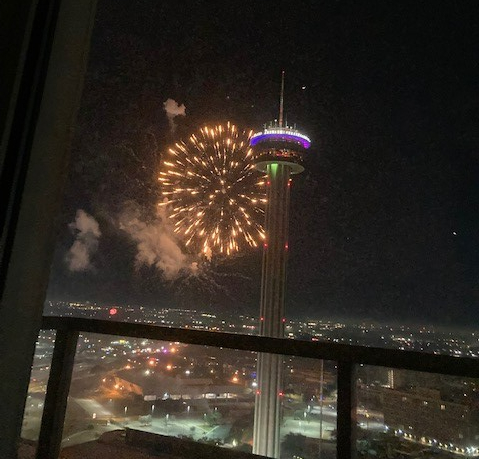
No, I am not talking about the New Year’s Eve fireworks outside our home, although they were certainly inspiring.
I am referring, rather, to an email I received from a reader who read A Potter’s Vessel over the holidays. I appreciate all of the feedback I receive and encourage you to write to me at the “Contact” tab above that is linked to my email address. I welcome any commentary, either positive or negative (although constructive, I hope). This reader was enthusiastically positive:
“I finished the book this morning! I’d say I enjoyed it as I couldn’t put it down and finished it in only five days.”
He went on to give me many helpful comments and finished with this:
“I love that you have an epic climax at the end but also that there are mini-climaxes throughout the story”.
I don’t need much encouragement to keep me going, but these comments were obviously a boost. Please let me know how you feel about my writing so that I can learn to express myself better. That is, after all, why I write. (See the “blog” tab above for a longer explanation.)
I intend to refocus on Volume 3 of the Secession Trilogy this month. 2022 was a challenging year for many reasons and I did not write as much as I had expected to. However, I have completed the first draft of Part 1 and have a strong conception of where the story is going and how it will end. This will include a new storyline that I had always had in the back of my mind, but which has recently crystalized and moved to the forefront. One of the minor characters to date is about to become a major figure in my re-imagined history of our Nation. I am excited to discover for myself where he might lead the story, and how his actions might inform even our Nation’s current events.
August 30, 2022
Multi-Tasking
I reported back in April that I had turned my primary focus to the production of my stage play, Precepts of Men? That project is still in the works, but progress continues to be hard to direct (appropriate term). I have not given up on the work actually reaching the stage, but the continued delay has compelled me to return to other projects and even start a new one.
I now have 35 pages written in the final volume of the Secession Trilogy, tentatively entitled Killing Force. I am encouraged by the progress and re-energized on the topic. Although I have always had a general outline of the end of the story in mind, my vision is expanding as I reread several resource works. Two are particularly informative and come closest to addressing my threshold premise (although neither ever does directly). The Broken Constitution, by Harvard law professor Noah Feldman, and Summoned to Glory, by Richard Striner, author, historian and retired professor at Washington College in Chesterfield, MD (a school I was not familiar with, but its students who took Striner’s courses were certainly well-taught). If my historical/political topic interests you at all, I strongly recommend that you read these two works (in conjunction with mine, of course).
Another of my favorite topics rarely needs re-energizing – Major League Baseball. I have been following it faithfully since I was about ten years old with very few interruptions and no frustrations (except the 1994 strike). I have been writing about the game for nearly ten years on my other website http://www.babesbaseball.com. As we move to the final month of the 2022 regular season and expanded post-season, I will be writing more about baseball and less about the Constitution. That may be a cause for all to celebrate, and I hope you will read some of my other work if you have not in the past.
In addition to this season commentary, I am also working on a book that will be part compilation of my ten years of blogging on the game as well as my now five-year quest to see a game in every MLB ballpark with my son. (We have been to 24 of the 32 parks – 2 of the 30 teams have built new parks since we began the quest.) This project truly promises to be a labor of love, as has the actual work on the B.A.B.E.S. blog and the coast-to-coast travel to ballparks with Jack.
All of these labors promise to make my Labor Day 2022 a productive time.
April 28, 2022
Blocked and Tackling
I am still reflecting on past work, and finding that the creative process is not a linear one. The first two volumes (all 975 pages) of the Secession Trilogy came to mind quite clearly and somewhat easily. After four months of effort, I have found the story in Volume Three to be much more challenging. I am not so much blocked, but simply indecisive about which plays to call next. So, after four months and fewer than twenty acceptable pages written, I have taken a break from historical fiction. Instead, I have renewed my effort to tackle the illusive production of a different project that was stymied in 2020 by COVID-19.
My stage play “Precepts of Men?” was in the pre-production phase in early 2020, but then went into hiatus along with all theatrical works around the world. Now, with the lifting of almost all pandemic restrictions (in Texas, at least), I am once again pursuing the production. Nothing is imminent, but I will continue to work on it while hoping that some clarity on how to complete the Secession Trilogy will come to my mind. I know how that story ends, but the journey has yet to fully present its path. With stage plays, I am learning, the story never really ends.
You can learn more about Precepts of Men? from its page under the Works tab. Stay tuned for updates on my progress with that production as well as any developments in my struggle with the Constitution and Mr. Lincoln.
January 19, 2022
A new year: time to reflect on past work…
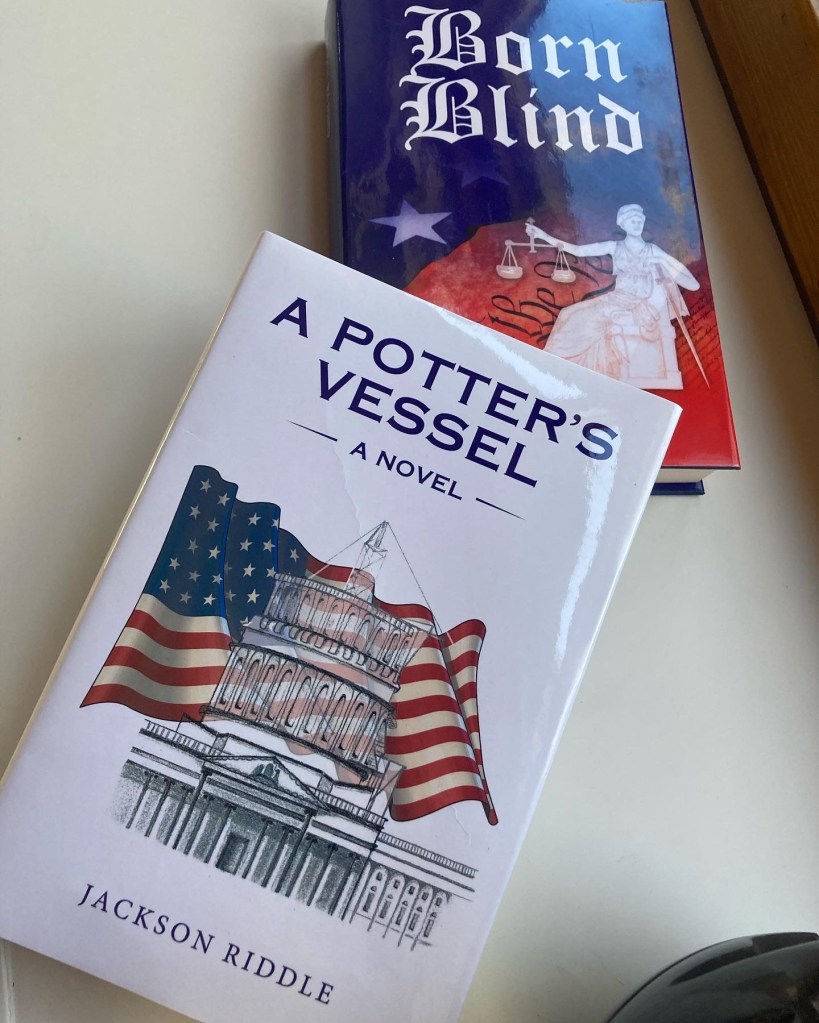
and look to the future.

The story continues…
November 23, 2021
Volume 2 of The Secession Trilogy – Now available on Amazon or your favorite online bookseller:

November 9, 2021
Coming in two weeks!

October, 2021
A Potter’s Vessel, the sequel to Born Blind, will be published in November.
The national crisis that erupted in Born Blind intensifies as Tennessee’s petition to withdraw from the Union goes to trial before the United States Supreme Court. The president and the congress strive to pre-empt the court’s verdict ahead of the elections of 1860.
Does the Constitution dictate that the votes of only five justices can validate Tennessee’s withdrawal? Or does the vote of the people and the congress trump the power of the judiciary?
Is the Nation still under construction, or is it destructing?
_________________________________________
August, 2021
Many thanks to The Boerne Bookshop, 153 South Main Street, Boerne, TX, for hosting a signing, and thanks to all of you who came out to buy a book, or two.
https://www.theboernebookshop.com/.

__________________________________________
June, 2021
A Question Becomes a Trilogy…
As a practicing lawyer for over thirty-five years and an instinctive adherent to the rule and process of law, I have become captivated by an anomaly from American history: why was the question of the constitutionality of secession never brought before the Supreme Court?
My consideration of this tragic departure from our country’s established legal procedures gained intensity a couple of years ago. I analyzed the matter through the lens of a litigation attorney, and was able to develop the legal structure for how such a question could have been presented to the Supreme Court. From that point, I quickly envisioned a storyline for dramatizing that effort.
After writing Part I of Born Blind, setting the stage for the Supreme Court case, I realized that a considerable amount of backstory needed to be told. I embarked on that process and discovered after writing another 400 pages that I was not going to be able to complete the story in a single volume. I have now about half-way finished writing the sequel, and there is even more story to tell.
If you have not already, I hope that you will read Born Blind this year, and then be ready for the advancement of the story with the publication of Vol. 2 before year’s end. I will continue to explore deeply these questions that I believe our Nation’s antebellum leaders should have answered before going to war.
____________________________________________________
January, 2021
Would a state’s petition to secede from the Union in 1860 have changed the course of American history?
Could the sacrifice of over 600,000 American lives have been averted if our self-proclaimed “government of laws, not men” had looked to the Constitution to resolve its greatest conflict?
Volume I of my secession trilogy is available from WestBow Press and several online outlets, including Amazon and Barnes & Noble. (Links below).
Born Blind is a novel about what should have happened in the United States in 1860, or any time prior to July 21, 1861, the date the Civil War truly began with the first Battle of Bull Run.
In this book, I have staged an alternative battle for the soul of the Nation – one fought in the Supreme Court chamber in Washington rather than in the cotton and wheat fields of the country’s heartland. The inherent limitations of the Constitution, and the flaws of the men who interpret it, are dramatically exposed in this legal struggle over the future of the Union.
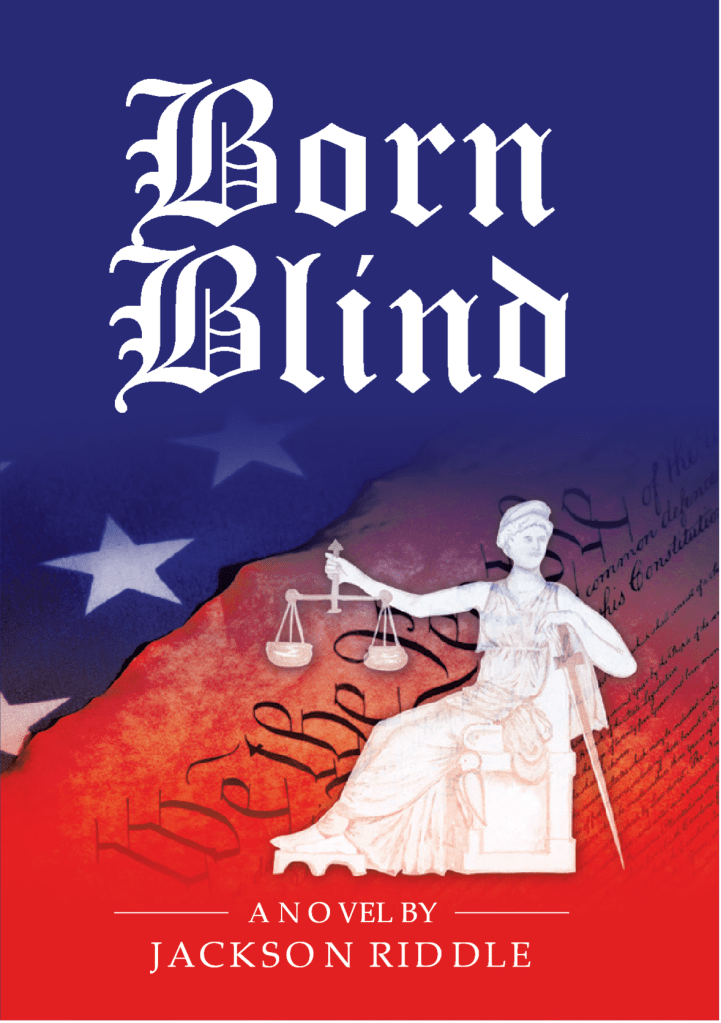
The story traces three generations of the Scott family who engage not only their own slaves, but historical leaders such as First Lady Sarah Polk and Supreme Court Justice John Catron, in the struggle to bring the Nation’s antebellum conflict to a constitutional – and peaceful – resolution. By convincing Tennessee to sue for the right to secede, Jerald Scott and his blind slave Gamaliel lead the fight to uphold the rule of law. In the process, they challenge the legacy of some of our Nation’s most revered leaders.
Was secession constitutional?
Was the president empowered to call-out troops from member states to fight troops from other states that no longer considered themselves members of the Union? Even if the departing states had acted illegally, could the Union forces legally attack them on the soil of one of those states?
Each of these questions could only be answered under the Constitution, and there was only one proper forum in which to render a verdict – the United States Supreme Court. No one ever asked the justices what the law is – until now.
Excerpt:
“You are not actually going to send that to Whitthorne?” This time Lee spoke with an accusation that also conveyed incredulity. “It’s a ludicrous idea.” Jerald rose, still holding the letter aloft, and finally looked at his brother.
“You know that I will,” Jerald said, standing and straightening the fine wool of his black waistcoat that distinguished him as a man of the world rather than of a school room, “and you know that I will carry the endeavor through as far as I am able.” He walked toward the fireplace and started to hand the paper to his brother. Looking down at the fire, he instead pulled that hand to his side, picked up an iron poker with the other, and began to work the coals. “You may think it a ludicrous idea,” he continued, “but I disagree strongly. We are a constitutional republic. We have judges appointed to interpret the Constitution, and I aim to have them do it. Whitthorne will be my ally in this.” He stood erect and handed the iron to Lee, who snatched it with one hand while pointing to the letter held at his brother’s side.
“Whitthorne,” Lee said, still incredulous, “just became Speaker, and you have only served one term in the house as a member of a dying party. How do you suppose that the two of you could lead the state assembly on such an astounding quest?”
“I will say again – we have a legal process, and I intend to see it through,” Jerald replied. “Whitthorne will support it because he loathes the idea of war. Governor Harris will support it because he is hot for secession and will consider any public discussion of it a benefit.” Lee scoffed and turned his back at the mention of Harris’ name, but Jerald continued. “The rest of my fellow legislators will support it for the same reasons, and because they know that the coastal states will act as they wish no matter what the United States Supreme Court says.”
“Well, then,” Lee said, “we should go to hear what Father has learned. ” He moved toward the door and put his hand on the black man’s arm. “Gam, please tell James to saddle Mister Jerald’s horse, and that we will accompany him back to Father’s.”
“I will tell him, Mister Lee,” the black man said, and he turned and moved deliberately out of the room. He ran his hand around the door frame and held it out lightly before him, as he walked with dignity down the hall toward the parlor. Lee watched him for a moment before turning back to glare at his brother, who was bent over his desk locking the top drawer.
“You still intend to free him?” Lee asked, again as an accusation, and then added to it. “And you still think a blind free African can survive in this country?”
“Your first question is a matter primarily between Father, Zechariah and Gamaliel,” Jerald answered, turning to his brother, “but to the extent I am involved, my answer is ‘yes.’” He drew closer, and Lee stiffened. “Your second question presents a problem involving God, Gamaliel and the Constitution. I think my plan is a solution that will honor each of them.” He put the key in his waistcoat pocket and walked decisively past his brother, out of the room and into the hall where Gamaliel stood holding his riding coat.
https://www.barnesandnoble.com/w/born-blind-jackson-riddle/1137740025?ean=9781664201422
https://www.westbowpress.com/en/search?query=born+blind.
https://www.amazon.com/b/ref=usbk_surl_books/?node=283155
_________________________________________
_________________________________________________________
OTHER WORKS
The Riddle Family Trilogy
RIDDLE IN THE SAND,
a novel –
Is idol worship ever a good thing? We all do it sometime in our lives, but few of us ever get the chance to make the act meaningful for the object of our idolatry. This story is one of those rare occasions. Follow Jackson Riddle’s worship, as he tries to balance it with his career and marriage to Maggie.
PRECEPTS OF MEN?,
a play in five questions
Maggie Riddle strikes back. Responding to Jackson’s first recounting of their relationship fifteen years earlier, Maggie finally expresses her view of herself, her husband, and their relationship. Several interconnected (and universal) topics are explored from inside the confines of the Riddle home, in this nearly one-woman play. This is a Texas woman who should be heard throughout the world.
WHEN WE ARE OLDER,
a family memoir (part 1)
Brought together initially by perceived Divine intervention, the Riddle family is shaped by extraordinary biological circumstances, emotional challenges and legal processes. The family members confront infertility, adoption, rebellion, lawlessness and forgiveness, with varying degrees of success.
What some people have said about my earlier works:
What’s in it for me?
In Field of Dreams, the movie adaptation of W. P. Kinsella’s book “Shoeless Joe,” the main character, Ray Kinsella, wants to go into the cornfield with the players. He wants to know what is out there. Indeed, he believes that he is entitled to know, because of all that he has done – building the field at great cost to himself and risk to his family – to enable the players to return to corporeality and again play the game they love.
When Shoeless Joe instead invites writer Terence Mann to come into the cornfield with them, Ray protests. “I did all of this for you, and I never once asked ‘what’s in it for me,'” he exclaims to Joe. “What are you saying, Ray?” Joe calmly inquires. “I’m saying,” Ray replies in exasperation, ‘What’s in it for me?!”
We have quoted this exchange in our home many times, mostly as a parenting device attempting to teach our children not to be self-centered or self-seeking. We use quotes from movies as well as other sources, such as the Bible, to bolster our teaching. “Do nothing out of selfish ambition or vain conceit. Rather, in humility value others above yourselves, not looking to your own interests, but each of you to the interests of others.” Philippians 2:3-4. Our intentions are honorable, but can we really expect our children to comprehend this lesson any better than Ray did, or we do ourselves? It is our nature to be self-centered, and to seek first to understand what any experience means for us or to us. Further, we are drawn to – even while fearful of – the unknown world that exists beyond our current understanding. The knowledge of it looms inevitably in our future, but few of us anticipate it with joy. I admit to all of these emotions, and, oddly enough, they are why I write.
Most writers will admit that writing is the ultimate act of self-absorption. Can there be any greater narcissism than to believe that others need to read what you think? Similarly, is there any greater vanity than to write knowing that it is likely that no one, or at least very few, will ever read your words? As a social/political commentator that I read, Glenn Reynolds, often remarks concerning such blunt evaluations: “Harsh, but fair.”
However, even though these criticisms may be true as well as fair, I still believe that by writing I can move closer to an understanding of how to manage my human tendencies. The process may not be strictly in compliance with Paul’s admonition to the members of the church at Philippi, but it could lead me there.

My favorite writer, William Faulkner, said that the problems arising from “the human heart in conflict with itself” are the only true inspiration for good writing. I believe that fighting our natural inclination to ask “what’s in it for me?” is simply another expression of this struggle. Ray’s question may not be as poetic as Faulkner’s phrase, but it is certainly more recognizable. We all experience it every day. Learning to balance our inclinations to focus on ourselves with the recognition that we exist in a greater context of life – and for a wider purpose – must surely be a universal experience. It could also be one means to resolve the conflict within all our hearts.
Although his writing is noted for its brutalist’s view of mankind, evidenced by the unflinchingly destructive nature of his characters, Faulkner professed to have a positive view of man’s destiny. In his speech in Stockholm accepting the 1949 Nobel Prize for Literature he rejected the notion that man’s existence will be perpetuated merely by his “puny, inexhaustible voice.” Rather, on the biggest literary stage imaginable, he boldly proclaimed:
I believe that man will not merely endure: he will prevail. He is immortal, not because he alone among creatures has an inexhaustible voice, but because he has a soul, a spirit capable of compassion and sacrifice and endurance.
When I read these words I am not surprised to learn that Faulkner believed man is eternal or that he did not see man’s survival as meaningless. Rather I am struck that he cites as proof of such immortality and meaning traits that are most associated with the humility that Paul spoke of to the Philippians. “Compassion and sacrifice,” and the “endurance” that is inevitably required to exhibit both, are expressions of “valuing others above yourself,” and “seeking their interests before your own.” It is the writer’s duty, Faulkner says, to write about these things, just as Paul makes it the duty of his readers to act them out. As one who has spent a good deal of time studying the writings of both Paul and Faulkner, it should not be surprising that I am determined to follow the advice of both. What better guidance for one’s writing – and life – could there be?
Faulkner further said that it is the writer’s “privilege to help man endure by lifting his heart, by reminding him of the courage and honor and hope and pride and compassion and pity and sacrifice which have been the glory of his past.” Paul wrote that “the fruit of the Spirit is love, joy, peace, patience, kindness, goodness, gentleness, faithfulness, and self-control.” (Gal. 5:21-22). Thus, Faulkner calls on us to be lifted by our past while Paul says that we can lift others in the present. I believe that these sixteen attributes they identify for this work will also provide the emotional fuel to propel us into a better future, perhaps even to heal the “human heart in conflict with itself,” and to cure our natural compulsion to ask first, “what’s in it for me?”
Endeavoring to inform my own writing with this understanding, I am further inspired by Faulkner’s promise that the voice of the writer “need not merely be the record of man, it can be one of the props, the pillars to help him endure and prevail.” What more could I ask for myself? What more should anyone aspire to? Which brings me back to Field of Dreams.
Ultimately, Ray acquiesces to Joe’s judgment (“you aren’t invited”!), and reluctantly agrees that Mann is the correct human choice to experience the corn field. Why? Because he can write about it afterward. “It’s what I do,” Mann proclaims. “There is something out there, Ray, and if I have the courage to go through with this, what a story it will make.” When Mann disappears into the corn field, laughing, I am reminded that writers lift man’s heart. Writers are supposed to go where others can’t go or are afraid to go. Indeed, they are invited to go there for the benefit of others. By accepting the invitation and enduring the challenges that follow they can help their fellow man endure.
Although his name is little known, and his writing does not move me purely by the force of his words as does Faulkner’s or Paul’s, I consider W. P. Kinsella’s “Shoeless Joe” story a classic of modern literature. Phil Alden Robinson, the screenwriter and director of the movie adaption, arguably improved on Kinsella’s actual storytelling. Naming the writer Terrence “Mann” was a bit of genius, elevating the character to a symbol more meaningful than even J. D. Salinger, whose identity was used in the book. (Salinger could not be named in the movie due to his threat of a lawsuit. Was J.D. asking “what’s in it for him?” or simply continuing to protect his own privacy?). Even with this and other significant plot changes in the screenplay, the idea for Field of Dreams still originated with Kinsella, and it has caused many people to reflect on life and eternity for over thirty years now. The fact that it uses baseball as the background just heightens the attraction, in my opinion (See my “Other Interests” sub-page under the “About” tab.) It is worth noting that perhaps the most moving iconic literary work about baseball was written by a Canadian. That underscores that the love of baseball is not uniquely American, but also that question Ray seeks to answer is present in any human context. (Kinsella famously said that he did not even like baseball!)
Many criticize the story and the movie as overly emotional and dramatic, yet I am still being lifted by it after numerous readings and viewings. That is what writing does – it moves some and agitates others. I would be honored to have that impact on my readers even though my name may be little, or even never, known. Wouldn’t that prove Faulkner correct concerning the inexhaustible voice of man? And wouldn’t that also reflect the ultimate personal advancement beyond the question, “what’s in it for me?”

Follow My Blog
Get new content delivered directly to your inbox.
 JACKSON S. RIDDLE